
"*" indicates required fields

949-269-7709Call For A Consultation
Santa Ana Construction Fraud Lawyer
Trusted Construction Fraud Attorney in Santa Ana
A Santa Ana construction fraud lawyer can help businesses, contractors, developers, and property owners when they are accused of fraud, misconduct, or other violations of laws and regulations in connection with a construction project.
Construction fraud claims often involve substantial fact investigation, document review, and analysis of project records to understand what happened and whether legal claims may exist. These matters can involve government investigations, financial issues, procurement issues, or disputes between parties to a project.
Engels-Janzen represents clients in complex construction-related matters and evaluates their legal rights, potential claims, possible defenses, and legal strategies under California law.
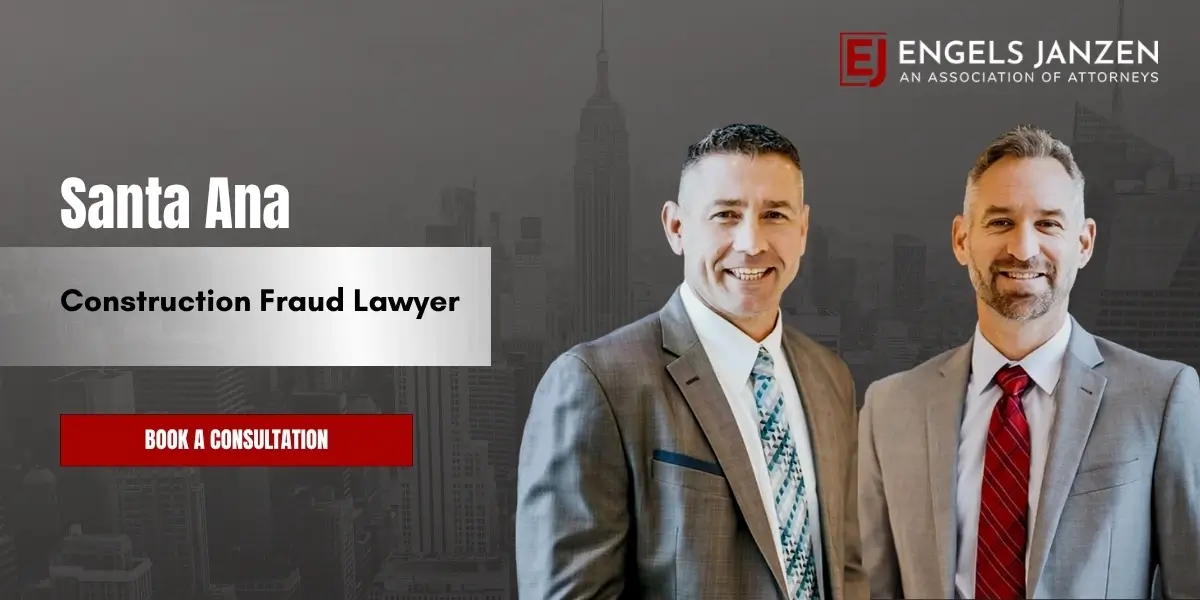
Hire a Construction Fraud Lawyer
Prior to becoming a lawyer, Christopher Engels worked in the construction industry for 25 years and has personal experience in construction project administration, bidding processes, contractor operations, and payment practices.
At Engels-Janzen, Christopher Engels and Sean Janzen work with businesses, contractors, developers, property owners, and other individuals involved in construction-related disputes in Orange County and throughout Southern California.
Engels and Janzen’s experience with complex construction issues allows them to offer practical advice and strategic legal representation unique to each client’s situation.
False Claims Act (FCA) Investigations
False Claims Act (FCA) investigations may be initiated if allegations surface about information provided in connection with construction projects involving government funding. The federal False Claims Act, 31 U.S.C. §§ 3729-3733, allows the government to bring claims based on alleged false statements, fraudulent billing, or other misconduct involving public funds.
An organization may need to preserve records, review project documentation, and evaluate relevant communications if an FCA investigation is opened regarding matters the company is handling.
Construction companies, developers, subcontractors, and consultants could all potentially be involved in such matters. An early evaluation of the allegations and evidence may be important in responding to government inquiries and assessing potential legal exposure.
Bid Rigging & Antitrust Issues
Bid-rigging and other antitrust issues frequently deal with questions about competitors affecting the bidding process through collusive activity. Price fixing, market sharing or customer allocation agreements, bid suppression, or leaking of pricing information are all examples of situations that are frequently at issue in these matters.
Cases can involve public works projects, privately funded development, and government procurements. Discovery may include bidding records, communication among bidders, subcontracting issues, and procurement practices. Claims may give rise to administrative investigations, civil actions, and criminal enforcement proceedings. A review of the facts is often required due to the voluminous and document-intensive nature of most antitrust claims.
Internal Investigations for Developers or Owners
Developers and property owners may choose to conduct internal investigations in response to concerns about project irregularities, suspected fraud, contract compliance, or employee misconduct. The goals of these investigations may include ascertaining what happened, who was responsible, and what legal exposure may exist.
Internal investigations may involve interviews, collection of documents, financial analysis, and review of project communications. Information uncovered during the course of an investigation may be used in litigation that is or may be filed in the Orange County Superior Court or other California courts.
A prompt investigation can help preserve evidence, establish disputed facts, and provide decision-makers with information for determining the right course of action.
Kickbacks, Overbilling & Embezzlement
Kickback, overbilling, and embezzlement allegations commonly focus on the issue of whether project funds were improperly diverted, concealed, misappropriated, or otherwise mishandled. The accusations can target vendors, subcontractors, employees, project managers, or other parties who had access to project funds.
Sometimes the suspicions relate to irregular payment patterns, inflated invoices, unauthorized expenses, or inconsistencies in project accounting records.
To resolve these issues, it may be necessary to track transactions, scrutinize supporting documentation, and analyze the financial relationships between the involved parties. These types of disputes can give rise to litigation, internal investigations, insurance claims, or attempts to recover alleged losses associated with a construction project.
Fraud Claims in Construction Litigation
Construction fraud claims can be made in connection with breach of contract, negligence, or other business causes of action. The claims usually involve an allegation that the other party deliberately misrepresented or concealed information, or that they committed fraud in the course of a construction project.
The United States Department of Justice reported that False Claims Act settlements and judgments totaled more than $6.8 billion during fiscal year 2025. The government continues to pursue enforcement actions alleging fraud and false claims for payment.
Fraud claims can take a long time to litigate because of the need to review many documents, depose witnesses, retain professionals, and evaluate damages. The outcome often depends on the specific facts and evidence involved.
Regulatory & Administrative Investigations
Allegations of construction fraud may also lead to investigations by government agencies, licensing boards, or other regulatory authorities. These investigations can involve matters related to compliance, business practices, procurement, and financial transactions associated with a project. In 2024, there were 859,532 internet crime complaints in the United States, with reported losses totaling over $16 billion.
Although construction fraud investigations involve different factual circumstances than internet-based fraud schemes, they can still expose businesses and individuals to significant financial losses and legal consequences. Regulatory investigations often involve responding to information requests, producing documents, and addressing concerns from enforcement agencies.
Whistleblower Construction Fraud Claims
Many construction fraud investigations are initiated based on information provided by a current or former employee, subcontractor, consultant, vendor, or other person with information about a project. Whistleblower complaints may include allegations of false billing practices, misuse of project funds, procurement issues, compliance violations, or other suspected improprieties.
In some cases, a whistleblower complaint can result in internal investigations, regulatory inquiries, civil litigation, or government enforcement actions. Analyzing these allegations frequently requires a review of project documentation, communication records, financial information, and other relevant evidence. An early investigation may assist in fact-finding, risk evaluation, and determining a course of action.
Contact a Santa Ana Construction Fraud Lawyer
Construction fraud claims can expose businesses and individuals to substantial financial risk, project delays, government investigations, and litigation. Suspected wrongdoing, internal investigations, government inquiries, or fraud allegations are all complex matters where knowing what evidence may be available is often key to understanding what you are facing.
Engels-Janzen represents businesses, contractors, developers, property owners, and others facing construction fraud-related disputes throughout Orange County and Southern California. Our lawyers work with you to understand the facts, to identify potential legal concerns, and to craft a strategy tailored to the unique circumstances of each matter. Schedule a consultation today to hire a construction fraud lawyer.
Contact Our Firm By Filling Out The Online Contact Form Or By Calling
Request A
Free Consultation
"*" indicates required fields
Call Us
Office Location
2900 Bristol Street,
Suite G205
Costa Mesa, CA 92626
© 2026 Engels-Janzen. All rights reserved.
Disclaimer | Site Map | Privacy Policy Digital Marketing By 
*Images are obtained under license from Canva and other third-party stock image providers, with attribution included where required.